

Imagine a crisp autumn day in the mountains, a damp walk through the forest, or a windy cliff by the coast. Getting something warm into your system isn't just pleasant—it's crucial for your energy and mood. This is exactly where the camping stove steps in to become your absolute best friend.
A camping stove is so much more than just a portable burner. It is a complete, well-thought-out cooking system built to perform when nature is at its most demanding. Its entire design is based on a brilliant idea: an integrated windscreen that keeps the flame stable and concentrates all the heat exactly where it's needed—on the pot.
Your reliable partner in all weathers
Where an open fire is impractical, dangerous, or simply forbidden, the camping stove guarantees you can cook food and boil water. It is your security for a warm cup of coffee in the morning or a fortifying meal after a long day's hike, regardless of the weather.
Unlike simpler, freestanding burners, a storm stove system is a package where all parts—windscreen, burner, and cookware—are designed to work in perfect harmony. Think of it as a small, mobile kitchen where every detail is optimized to provide maximum efficiency with minimum fuel consumption.
Why a camping stove is indispensable
Three core principles make the camping stove superior for most outdoor adventures. Once you understand these, you understand why so many experienced hikers and campers never head out without one.
- Efficiency: The windscreen does an incredible job of directing heat correctly, which shortens boiling time and makes your fuel last much longer.
- Safety: The flame is protected and enclosed. This dramatically minimizes fire risk and makes the stove safe to use even when the ground is dry.
- Simplicity: Most models are designed to be incredibly easy to use. You assemble it in an instant and are up and running with your cooking without hassle or frustration.
The "stormkök" is a true Swedish classic. It gained serious popularity when outdoor life became a national movement during the 20th century. The launch of the iconic Trangia stove in 1951, powered by methylated spirits, cemented its place in people's hearts and quickly became standard equipment for everyone from scouts to the military.
A good camping stove isn't an expense; it's an investment in warm meals, safety, and successful adventures. It's the difference between a cold, wet night and a fortifying meal that provides the energy to keep going.
When you choose a camping stove, you're not just buying a gadget; you're acquiring a reliable companion. It gives you the freedom to cook everything from a simple soup to more advanced dishes that brighten the evening in the tent or at the wind shelter. And when darkness falls, the right equipment is essential—a good camping lantern makes cooking both safer and cozier. Understanding the stove's basic function is the first step toward finding the right model for your specific adventures.
Which fuel is best for your camping stove?
Choosing fuel for your stove is a bit like choosing tires for your car—different conditions require completely different solutions. There is no magical fuel that is best for every situation. Your choice will affect everything from how fast the coffee boils and how heavy your backpack gets, to whether you can even get the stove started when the wind howls and the thermometer drops.
To make a smart choice, you need to know the three main types: alcohol, gas, and multi-fuel. Each type has its own unique advantages and disadvantages, making them perfect for different types of adventures. Let's break them down so you can feel confident about what you're packing.
The infographic below captures the essence of what a good camping stove is all about—efficiency, safety, and simplicity. All these points are directly affected by which fuel you choose.

Whether you choose alcohol, gas, or multi-fuel, the goal is the same: a reliable stove that delivers hot food without a lot of hassle.
Alcohol stoves – the quiet and reliable choice
The alcohol burner, usually filled with methylated spirits (denatured alcohol), is the old workhorse of the camping world. It is almost ridiculously simple. No moving parts that can break, no nozzles that can get clogged. It just works, period. This bomb-proof reliability makes it a favorite among both beginners and experienced veterans who value security above all else.
The advantages are obvious: the fuel is cheap and available to buy almost everywhere, and the burner itself is virtually silent. There is something special about only hearing the water start to simmer in the middle of the silence.
But there is, of course, a downside. Alcohol has a lower energy content, which means it takes significantly longer to boil water compared to gas. Performance also drops when it gets cold and windy, and fine-tuning the flame is more or less impossible. Furthermore, spilled spirits can be tricky since they burn with a nearly invisible flame in daylight.
Gas stoves – fast, convenient, and clean
The gas stove is the choice for those who prioritize speed and convenience. With a simple knob, you adjust the output with precision, and water boils in just a few minutes. The fuel burns completely clean and doesn't soot up your pots, making the cleanup afterward a breeze.
Gas canisters are lightweight, easy to handle, and the entire system is largely maintenance-free. It's an excellent choice for summer hikes and weekend trips where efficiency and simplicity are at the top of the wish list.
The challenge with gas arises when the temperature drops. Performance decreases significantly in the cold because the pressure in the canister falls. A standard gas mixture can stop working entirely around the freezing point. However, there is special winter gas that works better, but the cold remains gas's Achilles' heel.
Multi-fuel stoves – the workhorse for extreme conditions
When you're heading out on truly demanding expeditions, winter mountain tours, or traveling in countries where gas canisters are hard to find—then the multi-fuel stove is the unbeatable king. As the name suggests, it can run on several different liquid fuels, such as white gas (Coleman fuel), kerosene, and even diesel in an emergency.
This makes it extremely versatile and reliable in all temperatures. With a multi-fuel stove, you can melt snow and cook food efficiently even when it's freezing outside.
A multi-fuel stove, however, requires more knowledge and maintenance than its simpler siblings. You must preheat the burner to vaporize the fuel and regularly clean the nozzles to prevent them from getting clogged with soot.
To give you an even clearer picture, we've put together a comparison table summarizing the key differences.
Comparison of fuel types for camping stoves
The table below provides a quick overview of the strengths and weaknesses of the three most common fuel types, so you can more easily see which one is best suited for your next adventure.
| Feature | Alcohol (Methylated Spirits) | Gas (LPG) | Multi-fuel (White Gas/Kerosene) |
|---|---|---|---|
| Boiling time | Slow | Fast | Very fast |
| Cold weather performance | Poor | Poor (unless winter gas) | Excellent |
| Weight | Medium (higher fuel weight) | Low (lightest for short trips) | High (heavier burner) |
| Ease of use | Very easy | Very easy | Requires practice |
| Maintenance | None | None | Regular |
| Cost (fuel) | Low | Medium | Low (white gas) to high |
| Suitable for | Summer, beginners, short trips | 3-season use, weekend trips | Winter, expeditions, travel |
The choice of fuel simply sets the tone for your cooking in the great outdoors. By matching the fuel type with your planned adventure, you ensure that your camping stove always performs at its best and that you get to enjoy a warm meal when you need it most.
How to choose the right camping stove for your adventures

Finding the perfect camping stove is actually quite simple. It's all about understanding yourself and your adventures. It's easy to get lost among technical specifications, but the key is to ask the right questions.
Are you a solo hiker who counts every gram? Or a family that needs to be able to cook large meals at the campsite? Maybe a winter enthusiast who demands maximum power when the thermometer drops below freezing?
The answers to these questions determine everything. An ultralight stove is a dream for someone walking long distances but can feel frustratingly small for two. A large and stable stove is perfect for base camp but quickly becomes an unnecessary burden in the backpack. Let's break down the most important factors so you can make a smart and well-informed choice.
Consider weight and pack volume
For the hiker, weight and pack volume are almost everything. Every gram counts when you're carrying your entire home on your back. A compact camping stove that packs down into a small, convenient unit is worth its weight in gold. This is often where top-mounted gas stoves and smaller alcohol stoves shine.
But if you primarily paddle a canoe, camp with a car, or are just out on day trips, then weight matters much less. Then you can instead prioritize a more stable stove with larger cookware. Think about how you will mostly be transporting your gear—it's essential.
Capacity – for one or many?
How many hungry bellies do you need to feed? This is a crucial question. Most standard stoves, like the classic Trangia 25 series, are made for 2–4 people. Smaller variants, like the Trangia 27, are better suited for 1–2 people. Consider not just the size of the pots, but also how powerful the burner is.
- The solo hiker: A small and light stove with a pot of about 1 liter is often more than enough. Perfect for boiling water for freeze-dried food and a cup of coffee.
- The couple: Choose a system with two pots and preferably a frying pan. This gives you the freedom to boil pasta and heat sauce at the same time. Much more pleasant that way.
- The family or group: This requires a larger stove, maybe even two. If you're not carrying the gear far, a heavy-duty camping stove with multiple burners might be the best choice.
Buying a stove that is too small is a classic mistake. it only leads to frustration and causes cooking to take forever. Be honest about your needs, and choose a slightly larger system if you're unsure.
Planning for energy is also part of the adventure. In addition to fuel for the stove, it's smart to have a backup for your electronics. Supplementing your gear with portable solar panels to charge power banks and phones can make a big difference on longer trips.
Material and durability
The material of the stove affects weight, price, and how quickly you get food on the table. The most common materials are aluminum and stainless steel.
Aluminum is the most popular choice, and it's easy to see why. It's incredibly light and conducts heat extremely well, which means faster boiling times and less fuel used. Many modern stoves use hard-anodized aluminum, which makes the surface more resistant to scratches. Some also have a non-stick coating that makes both cooking and cleaning a dream.
Stainless steel is significantly heavier, but in return, it's almost indestructible. It's incredibly durable, easy to clean, and handles high temperatures without issues. If you prioritize durability over low weight—for example, for paddling or car camping—stainless steel is a superb choice.
By thinking through these points—weight, capacity, and material—based on your specific needs, you can find a camping stove that becomes a faithful friend. A stove you can rely on, which will grace countless adventures for many years to come.
Using your camping stove safely and efficiently
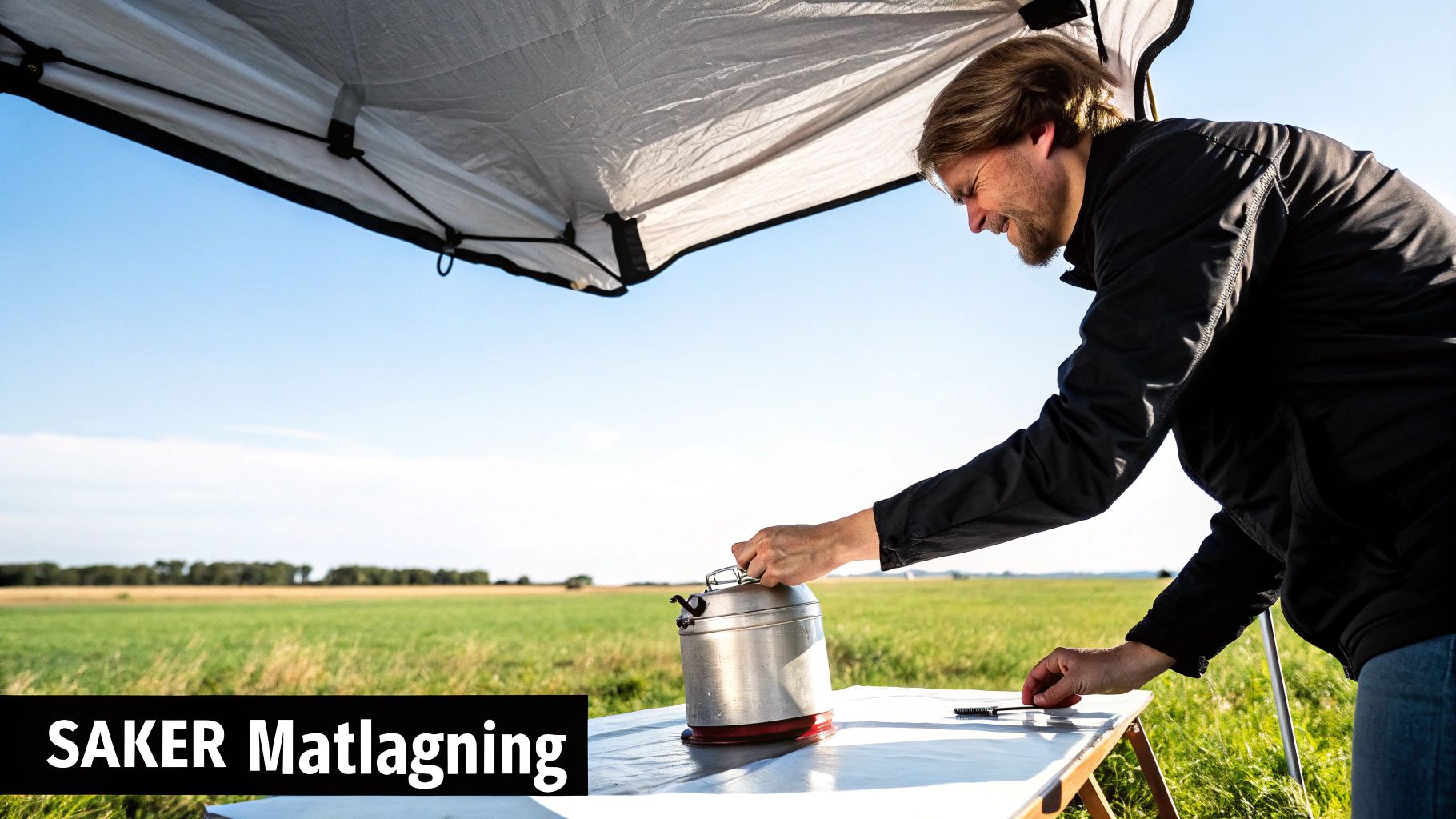
Unpacking your camping stove and getting ready for the first meal out in the wild is a special feeling. That's when the adventure truly begins. But for cooking to be an enjoyable moment rather than a frustrating struggle against the elements, you need to know the technique.
Lighting a camping stove is easy once you know the basics. See this part of the guide as your practical handbook—from a packed stove to a steaming hot dinner, both safely and fuel-efficiently. We'll take it step by step, from finding the perfect spot to those little tricks that make all the difference.
Preparation and choosing a location
The very first thing you do, even before taking out the stove, is to scout for a good spot. Safety is everything, and a stable foundation is essential for successful cooking.
Look for a flat and firm surface. A large, flat stone or a patch of gravel or sand is perfect. This minimizes the risk of the stove tipping over, which could lead to both a spilled dinner and, in the worst case, a fire.
A classic mistake is placing the stove directly on moss or dry grass. It only takes a small fuel spill or a single spark for it to catch fire. Always take the time to find or create a safe surface.
If you're having trouble finding a good spot, you can actually create one yourself. With a clever multi-tool, like a survival shovel with multiple functions, you can quickly clear away flammable material and level the ground. Presto, you have a safe cooking area!
Step-by-step assembly
Once the site is secured, it's time to assemble the stove. How you do it differs slightly between models, but the basic principle is usually the same.
For a classic alcohol stove:
- The windscreen: Place the lower part of the windscreen on the ground. Check that the air holes are facing the wind—this provides a better draft and a more efficient flame.
- The burner: Place the alcohol burner in the center. Fill it to a maximum of 2/3 with methylated spirits. If you fill it more, it risks boiling over when it gets hot.
- Assemble: Put on the upper part of the windscreen and turn it so that the pot supports fold out and lock into the lower part.
- Ignite: Light the burner carefully. Give the flame a moment to stabilize before putting the pot on.
For a hose-mounted gas stove:
- The burner: Fold out the legs on the burner and ensure it stands steadily.
- Connect the gas: Screw the hose onto the gas canister. Tighten it firmly, but without using excessive force.
- Windscreen: Place a separate windscreen around the burner. It makes a huge difference to the efficiency.
Following these steps ensures a stable and safe setup every time.
Tips for more efficient cooking
Getting a flame going is one thing, but using it smartly is another. With a few simple tricks, you can shorten boiling time, save fuel, and get the most out of your camping stove.
One of the most important tips is to always use a lid on the pot. It might sound obvious, but it cuts boiling time by up to 50%. The heat simply stays where it's supposed to be—in the pot.
Here are more techniques to become a master chef in the field:
- Preheat the alcohol burner: Let the burner run for about a minute before putting the pot on. This allows the spirits to vaporize properly, resulting in a much hotter and cleaner flame.
- Protect the gas from cold: When it's cold, the pressure in the gas canister drops and performance worsens. Warm it up by keeping it in your sleeping bag for a while before cooking, or place it in a bowl of lukewarm water.
- Use the simmer ring: Alcohol burners come with a small ring with a lid, a simmer ring. Place it over the flame to restrict the oxygen supply and lower the heat. Perfect when food just needs to simmer or be kept warm, and it saves a lot of fuel.
- Plan your cooking: Boil all the water you need at once instead of in batches. Add pasta or rice only when the water is at a rolling boil.
By mastering these tricks, you'll not only be faster at cooking, but you'll also ensure that your fuel lasts the entire trip. Every drop counts when you're far from home.
Care and maintenance for a camping stove that lasts
A camping stove is not a disposable item. On the contrary, it is a faithful companion that, with a little love, can accompany you on adventures for decades. Spending a few minutes on care after each trip is a small investment that pays off a hundred times over in the form of reliability when you need it most.
Start viewing your camping stove as an equally important piece of gear as your hiking boots or your tent. With a few simple routines, you ensure it's always ready to deliver a warm meal, no matter the weather.
It involves everything from basic safety in the field to smart cleaning and proper storage at home. Let's go through the steps that make your stove nearly immortal.
Safety first – always
Before we even talk about cleaning, we must address the most important thing: safety. Handling fuel and an open flame requires respect and common sense. Some rules are simply non-negotiable.
- Never refill a hot burner: This applies especially to alcohol stoves. Pouring spirits into a hot burner can cause the vapors to ignite with a puff. Let it cool down completely first.
- Check gas connections: When you screw on a gas canister, listen closely. Do you hear a hissing sound? Then it's leaking. Do you smell gas? Unscrew the canister immediately and inspect the seals.
- Always keep watch: Never leave a lit stove, not even for a second. The wind can change, a pot can tip over—an accident happens fast.
A golden tip: Get to know your stove before you head out. Test run it at home in a safe environment. Practice assembling, lighting, and extinguishing it until it's second nature. Then you'll feel confident when it really counts.
Cleaning after every trip
Sure, it's tempting to just shove the dirty stove into your backpack after a long day's hike. But don't do that. Washing up immediately after eating makes the job so much easier.
A smart trick is to boil a little extra water while you eat. Pour it into the used pot and let it sit for a while. The heat dissolves most food residues, and you can often get by with just a cloth, completely without dish soap.
If you must wash up in nature, do it responsibly. Go a good distance away from lakes and streams before pouring out the dishwater. Let the ground filter it instead of polluting our water sources. For really stubborn dirt, special cleaning wipes can be a lifesaver—effective, lightweight, and mess-free.
Deeper maintenance and smart storage
Between your adventures, your camping stove deserves a little extra care. This is especially important for gas and multi-fuel stoves that have more parts and nozzles that can get clogged.
Clean the nozzles: If the flame on your gas stove suddenly becomes uneven or weak, the nozzle is likely clogged with soot or dirt. Most stoves are sold with a small tool featuring a thin needle just for this. Simply follow the manufacturer's instructions.
Storage: When you get home, make sure the stove is completely dry before packing it up. Moisture is an enemy that can lead to rust and corrosion, especially if there are food residues left. Store the stove in a cool, dry place. And remember: always disconnect the gas canister before bringing the stove inside.
By following these simple tips, you turn your camping stove from a gadget into a lifelong companion. A well-maintained stove is a reliable stove—and that's exactly what you want when your stomach is growling and adventure calls.
Frequently asked questions about camping stoves
Theory is one thing, but when you're actually out there with the pots in hand, plenty of questions can arise. Here we've gathered some of the most common concerns—and given you straight, simple answers that actually work in practice.
How much fuel should I pack?
This is probably the most common question of all, and it's absolutely crucial. The answer depends, of course, on weather, wind, and what's on the menu, but there are good rules of thumb to follow. No one wants to carry too much weight, but running out of fuel is a true nightmare.
- Alcohol stove: Aim for about 1 deciliter of methylated spirits per person per day. This usually suffices for breakfast porridge, a cup of coffee, and a substantial dinner.
- Gas stove: A small gas canister of 100 grams usually lasts one person for a weekend. If there are two of you on a trip, a 230-gram canister is a safe bet.
Pro tip: Always test run the stove at home before a longer hike. Boil a liter of water and time how much fuel is used. Take notes, and then pack a small extra reserve—just in case.
Can I use a camping stove when there is a fire ban?
Yes, usually it's fine. A camping stove has an enclosed flame and is therefore considered much safer than an open fire, which means it is normally allowed even when a fire ban is in effect.
But, and this is extremely important: always check the specific rules for where you are. The municipality or County Administrative Board may have issued stricter regulations during extreme drought. Additionally, always place the stove on a safe, non-flammable surface like a rock slab, gravel, or sand—far away from dry grass and moss.
Aluminum or stainless steel – which is better?
The choice between aluminum and stainless steel pots boils down to one simple question: do you prioritize low weight or extreme durability?
Aluminum is the obvious choice for the lightweight enthusiast. It's super light and conducts heat incredibly efficiently, resulting in faster boiling times and lower fuel consumption. Perfect for the ounce-counter and those hiking long distances.
Stainless steel is significantly heavier but, in return, almost indestructible. It withstands rough handling, doesn't scratch easily, and is easier to clean. A clear choice for paddle trips, car camping, or other adventures where every gram doesn't count.
Being properly prepared is essential for a successful adventure. At ActionKing, you'll find a wide range of outdoor equipment to complement your camping stove, from smart accessories to powerful lighting. Explore our range and make sure you're ready for your next trip into the wild. Visit us at https://actionking.se today.


