

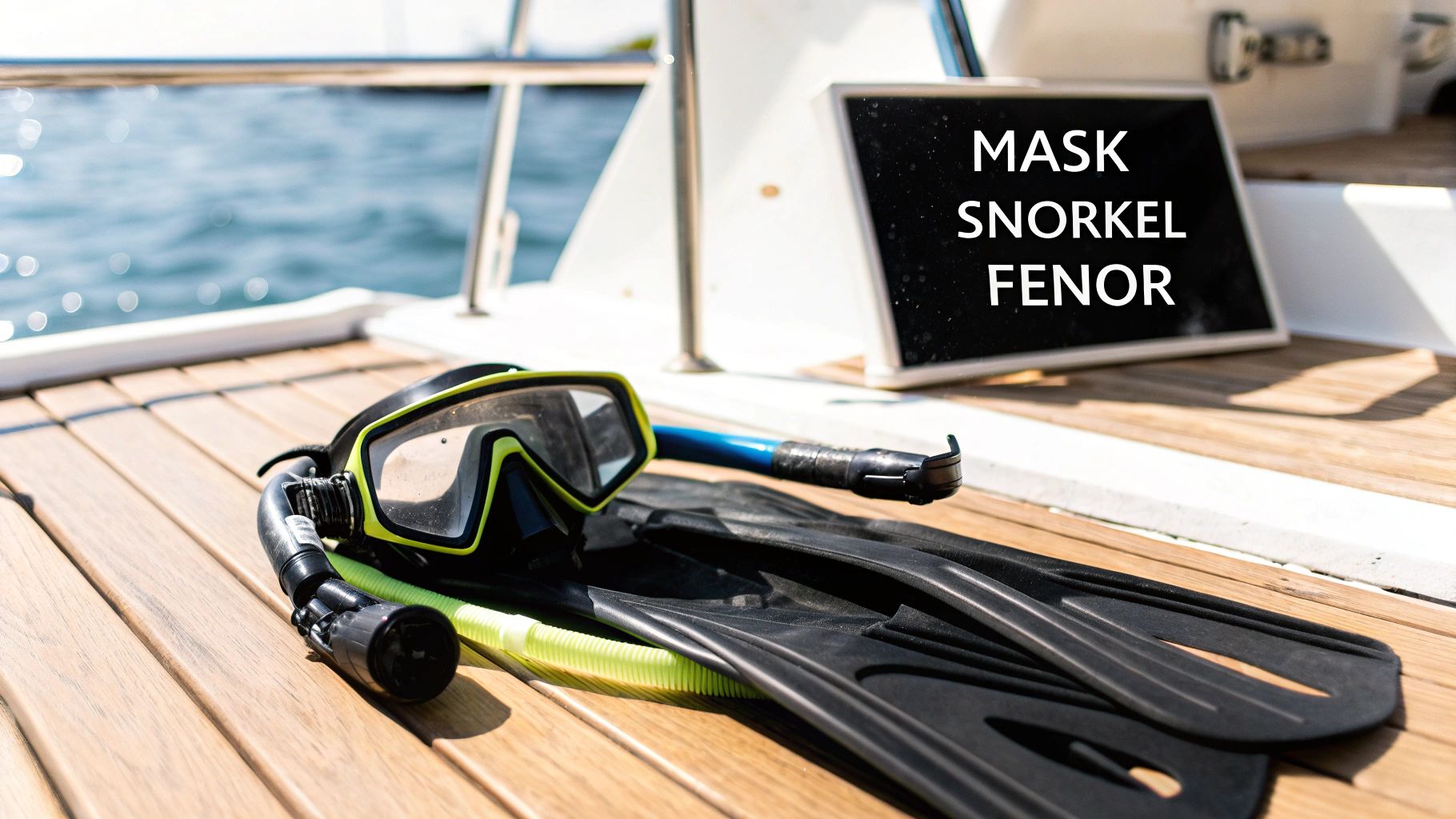
Diving is about discovering an entirely new world, and it all starts with the most fundamental gear. Think of your mask, snorkel, and fins as your personal ticket down there. This is your core trio for seeing clearly, breathing at the surface, and moving with minimal effort.
The Basics of Your Diving Equipment
Assembling your first set of diving equipment can feel overwhelming, but your ABC gear—meaning your mask, snorkel, and fins—is actually surprisingly simple to understand. These aren't just gadgets for beginners; they are the very foundation of every dive you will ever make, no matter how experienced you become.
Think of your diving mask as your personal panoramic window. Water completely distorts our vision, but by creating a small pocket of air in front of your eyes, you regain focus. Without a mask that fits perfectly, it is practically impossible to dive.
The fins? They are your motor. They transform your leg kicks into efficient propulsion and allow you to glide through the water like a fish, saving both energy and precious air.
Choosing the Right Mask is Absolutely Crucial
The most important thing about a mask is the fit. Forget about colors and brands for a moment. A mask that doesn't seal tightly will leak, which is a constant source of irritation and can ruin an entire dive. This is one of the most common beginner traps.
A classic trick for testing the fit is the "suction test." Place the mask against your face without using the strap. Inhale slightly through your nose and hold your breath. If the mask stays in place on its own, even when you lean your head forward, you have a winner.
When choosing, consider the following:
- Volume: A low-volume mask sits closer to the face. This makes it easier to clear of water if a leak should occur.
- Field of View: Some models offer a wider field of view, which is fantastic for truly taking in the magnificent environments below the surface.
- Material: Ensure that the "skirt"—the soft part that seals against the skin—is made of high-quality silicone. It is soft, durable, and provides a superior seal.
For those who want to film their adventures, there are smart solutions available. A diving mask with a camera mount is an excellent choice for easily mounting an action camera and capturing everything from your own perspective.
This image provides a quick overview of how to think when choosing your first equipment.

As you can see, it all starts with the ABC package. Only once you have that in place is it time to start thinking about more advanced components like a regulator and BCD.
To make it even easier, we have put together a small comparison.
Quick Guide for Choosing Basic Equipment
A comparison of the three fundamental parts and what you as a beginner should prioritize.
| Equipment | Key Function | Things to Consider | Best Suited For |
|---|---|---|---|
| Diving Mask | Provides clear vision underwater | Fit is everything. Look for soft silicone and low volume. | All divers, regardless of level. |
| Fins | Creates propulsion and saves energy | Choose between full-foot and open-heel. Match stiffness to your strength. | All divers. Open-heel is standard in Swedish waters. |
| Snorkel | Allows you to breathe at the surface | Comfort and a good purge valve make a big difference. | Primarily for saving air on the way to/from the dive site. |
This table clearly shows that while all parts are important, a perfectly fitting mask is truly the alpha and omega of a great experience.
Understanding Fin Functionality
Fins are not just fins. Their design has an enormous impact on how much power you get out of each kick and how tired your legs become. There are essentially two types to keep track of: full-foot fins and open-heel fins.
Full-foot fins are worn like a shoe and used barefoot. They are popular for snorkeling and diving in warm waters. Open-heel fins, on the other hand, require you to wear neoprene diving boots. This makes them the obvious choice for diving in cooler Swedish waters where you need to keep your feet warm.
When choosing fins, the stiffness of the blade is a key factor.
- Soft Fins: Require less power but don't provide the same thrust. Perfect for calm, relaxed diving.
- Hard Fins: Provide maximum power but require strong legs. Often used by technical divers or when diving in strong currents.
Many modern fins also feature smart technology like "split fins" or channels to direct water more efficiently and make you faster. If you have the chance, try out different models. It's the best way to find a pair that suits your body and your kicking technique.
Your Life Support System Beneath the Surface
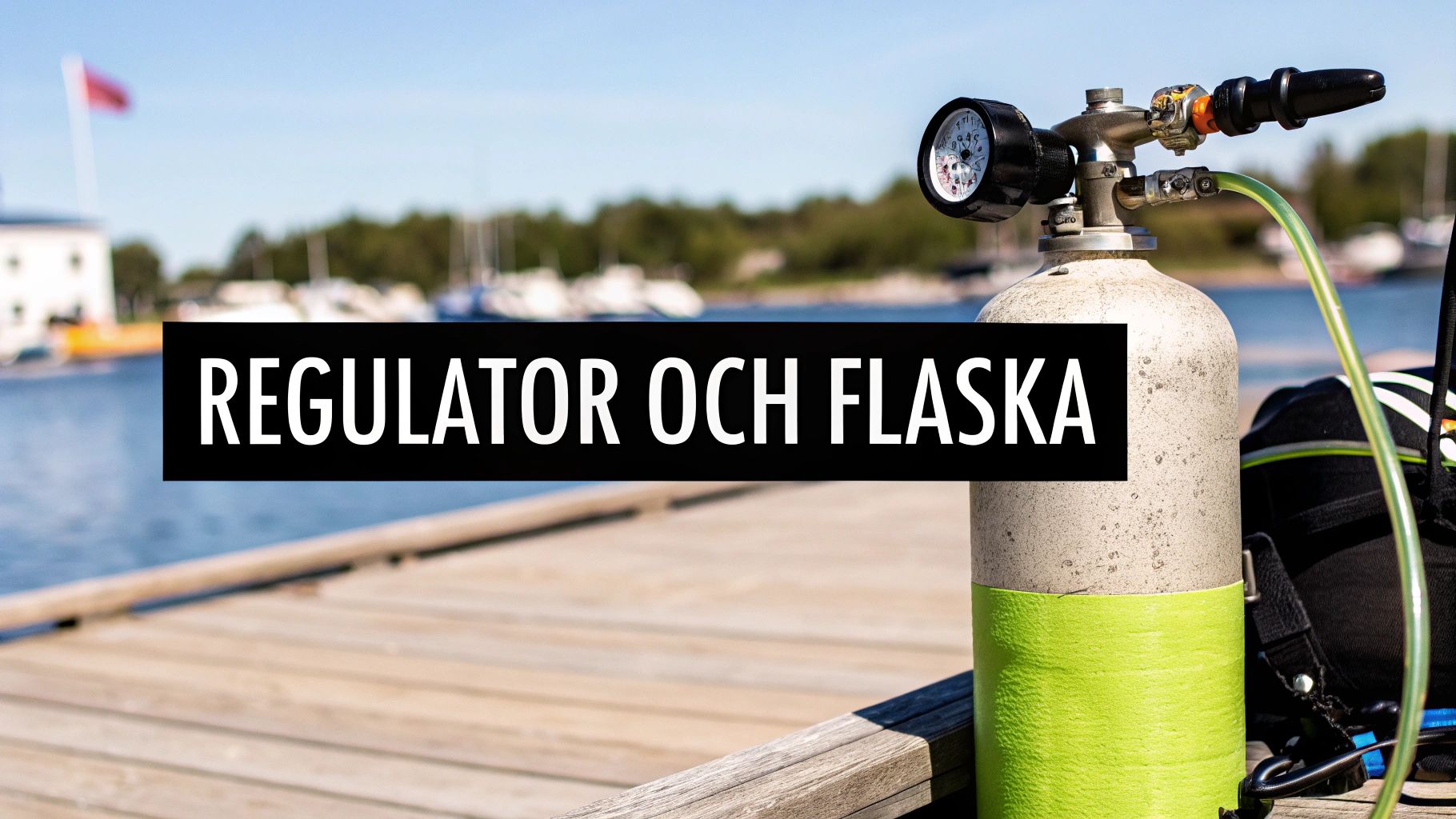
The heart of your entire scuba gear is the system that almost magically allows you to breathe completely normally, tens of meters below the surface. This is your lifeline, consisting of the scuba tank and the regulator. Together, they represent a masterpiece of engineering, created with a single purpose: to provide you with air, safely and reliably.
Think of the scuba tank as a powerful battery, packed with compressed air. The regulator is the smart adapter that converts the extreme pressure in the tank to a pressure that your lungs can easily handle. Without this duo, diving as we know it today would be impossible.
To truly understand your equipment, we need to take a closer look at the regulator. It's not just a single item, but a system of interconnected parts working in perfect harmony to deliver air exactly when you need it.
Step by Step: From Tank to Lungs
The regulator's job is performed in two main stages. Each stage has a specific task: to lower the pressure from the tank, which is often at 200 to 300 bar, down to the ambient pressure of the water surrounding you.
The first stage is the part you screw directly onto the scuba tank. Its sole task is to cut the high pressure and lower it to a more manageable intermediate pressure, usually around 8–10 bar above ambient pressure. This is where all your hoses originate.
The second stage is the mouthpiece you actually have in your mouth. It receives the air at intermediate pressure from the first stage and fine-tunes the pressure one last time so that it exactly matches the water pressure at your current depth. When you inhale, a slight vacuum is created that opens a valve and delivers air. Simple and ingenious.
Understanding how your regulator works is fundamental to your safety. It's not just a piece of gear; it's the system that connects you to the surface, even when you are deep down in the silent blue.
In addition to your primary second stage, you also have an alternate air source, usually called an "octopus." It is an extra second stage with a longer, bright yellow hose, intended to be given to your dive buddy in an emergency situation.
Diving in Cold Swedish Waters
When diving in Sweden, where water temperatures often drop below 10°C, completely different demands are placed on your equipment. A standard regulator that works flawlessly in the tropics can quickly become a safety risk at home. The problem is called "free-flow"—ice formation inside the regulator causing it to lock in the open position and blow out all your valuable air uncontrollably.
Therefore, a cold-water rated regulator is an absolute must. These models are smartly designed to counteract ice formation:
- Environmental Sealing: Sensitive moving parts in the first stage are completely isolated from the cold water, drastically reducing the risk of freezing.
- Heat Exchangers: Often there are small metal fins near the second stage that help transfer heat from the water to counteract the cold generated when the air expands.
The development of this type of specialized equipment has a long history in Sweden. From the diving bells of the 17th century to pioneers like Arne Zetterström in the 1940s, technology has been constantly refined for our demanding conditions. Read more about the fascinating development of Swedish diving equipment.
Safety and Maintenance are Your Responsibility
Your regulator is a robust yet sensitive piece of equipment that requires care. Blindly trusting that it will function without maintenance is a risk you should never take. Regular servicing and careful inspections are crucial.
A complete service should be performed by a certified technician, usually once a year or according to the manufacturer's recommendations. During this process, the regulator is disassembled, cleaned, and wear parts are replaced.
Before every dive, it is also your responsibility to perform a quick functional check. It is a simple but vital routine:
- Check the pressure: Open the tank valve slowly and ensure the pressure gauge shows a full tank.
- Listen for leaks: Listen carefully for any hissing sounds that could reveal a leaky connection.
- Test breathe: Take a few breaths from both your primary second stage and your octopus to feel that the air flows smoothly and without resistance.
By understanding and respecting your life-support system, you build the confidence needed to relax and fully enjoy your adventures beneath the surface.
Achieving Weightlessness with BCD and Weight Systems
One of the most magical sensations in diving is hovering completely weightless, almost like an astronaut in space. You achieve that total freedom by mastering your buoyancy control, and your two most important tools for that are your BCD and your weight system. These two components of your diving gear work in perfect symbiosis to give you complete balance underwater.
Think of your BCD, or Buoyancy Control Device, as a smart combination of a backpack and an inflatable life vest. It holds the scuba tank securely on your back and allows you to fine-tune your position in the water with millimeter precision. With a simple button press, you can add a little air to rise or release air to sink.
But it's about more than just comfort. Having full control over your buoyancy is essential for safety, while also protecting fragile marine life. An accidental nudge against a coral can cause damage that takes decades to heal, so precision is everything.
Choosing the Right BCD for Your Needs
When looking at BCDs, you will encounter two main types: jacket-style and wing-style. The choice between them depends largely on how you want to position yourself in the water and what feels best on your body.
A jacket-style BCD is the classic model that most people learn to dive with. Air fills both on the back and around the sides, providing a very stable and upright position when you are at the surface. It feels a bit like a standard vest and is usually very easy to adjust.
A wing-style BCD instead has the entire air bladder on the back. This gives you a more streamlined profile and a naturally horizontal position while swimming, something many experienced divers love. At the surface, however, it can feel a bit different and may try to tip you forward if you're not used to it.
Mastering your BCD is a bit like learning to ride a bike. In the beginning, it's wobbly and you overcompensate constantly, but soon the adjustments become second nature. The goal is to find neutral buoyancy—that perfect state where you neither sink nor rise, but simply hover.
Regardless of which type you choose, fit is absolutely critical. A BCD that is too large will slide around and make you unstable, while one that is too small will be uncomfortable and can even restrict your breathing. Try it on carefully!
The Weight System—Your Ticket Downward
Your body, your wetsuit, and even the air in your lungs all want to float. To get below the surface at all, you need a counterweight. This is where the weight system comes in—a fundamental part of your diving equipment.
There are two common ways to carry your lead weights:
- Traditional Weight Belt: A simple belt with lead weights that you buckle around your waist. The advantage is that it's inexpensive and very easy to remove in an emergency. The disadvantage is that it can feel clunky and put strain on the lower back.
- Integrated Weights: Here, the weights are placed in special pockets directly on your BCD. This distributes the weight much more evenly across the body and is significantly more comfortable. The pockets almost always have a quick-release mechanism that makes it just as easy to dump the weights if needed.
Today, most modern BCDs have integrated weight systems, and it has become the standard for many divers precisely because of the superior comfort.
Finding the exact right amount of weight is a bit of an art and depends on your body, the suit you're using, and whether you're diving in fresh or salt water. With the correct weighting, not only will the dive be more enjoyable—you will also consume significantly less air because you won't have to fight to stay in place.
Choosing the Right Suit for Cold Swedish Waters
Staying warm is not just a matter of comfort when diving in Sweden—it's a pure safety issue. The water here is cold, often below 10°C even in the middle of summer. Without the right protection, a dive quickly becomes miserable and, in the worst case, directly dangerous.
Your diving suit is therefore one of the most important pieces of your diving equipment. It acts as your personal thermos and protects against hypothermia, allowing you to enjoy longer, safer, and more relaxed dives. Choosing the wrong suit can shorten your dive from an hour to ten minutes and ruin the entire experience.
Wetsuit or Drysuit?
There are two main types of suits, and for Swedish conditions, the choice is usually quite simple.
A wetsuit works by letting in a thin layer of water between the suit and your skin. Your own body heat then warms up this water, which in turn acts as insulation. It's a perfect solution for diving in warm, tropical waters, but in Sweden, it is rarely sufficient.
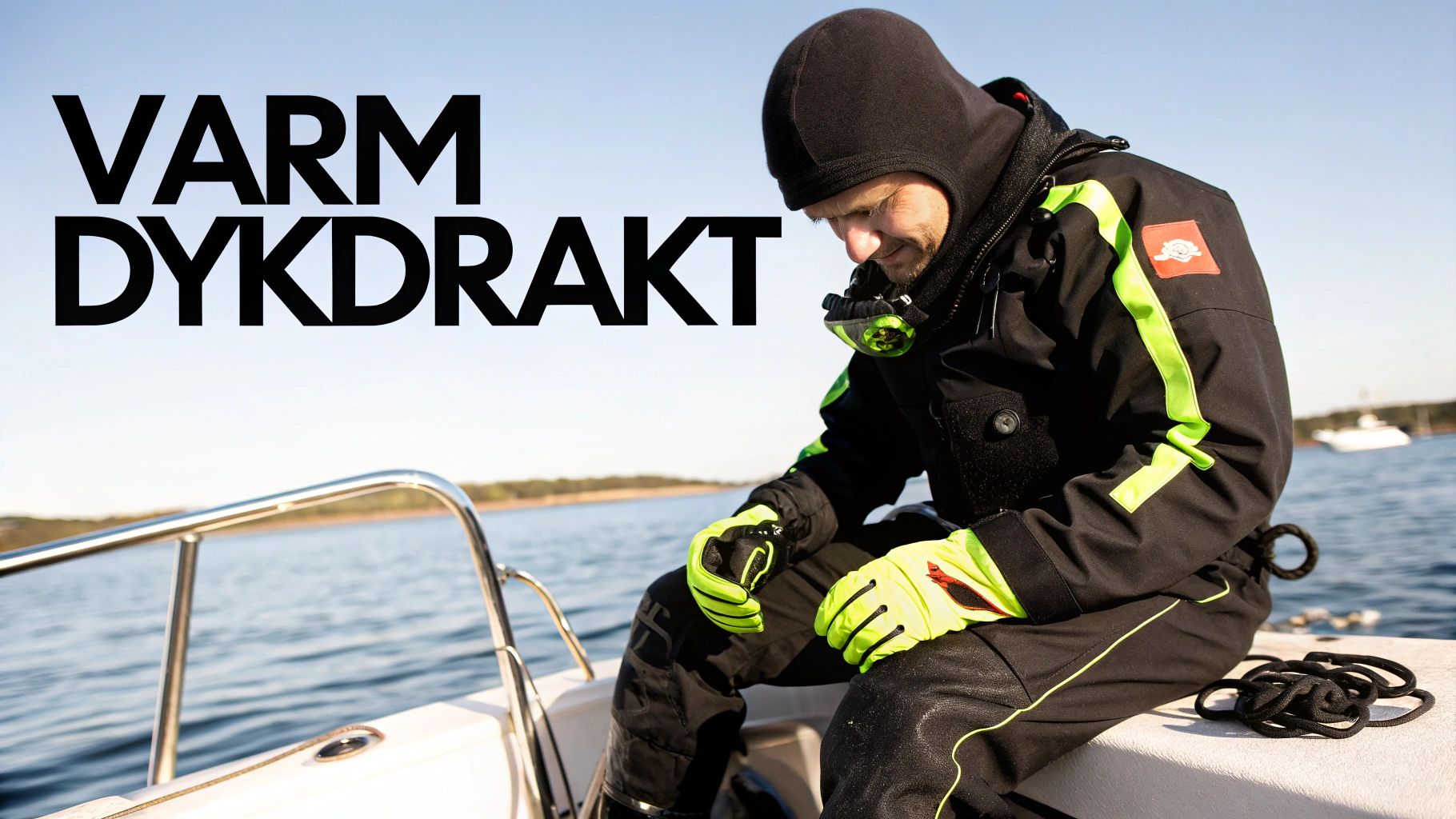
A drysuit, as the name suggests, is designed to keep you completely dry. It has tight seals at the wrists and neck, as well as a waterproof zipper that keeps out all water. The insulation doesn't come from the suit itself, but from the air inside and the clothing—the undersuit—that you wear underneath. For year-round diving in Sweden, the drysuit is the obvious choice.
Investing in a good drysuit opens the door to diving 365 days a year. It's the difference between being a seasonal diver and being able to explore the amazing underwater world even during autumn, winter, and spring.
The need for specialized equipment for our cold waters has actually been a driving force for development in Sweden. After an accident in Stockholm in the 1940s, the lack of adapted diving equipment became clear, which spurred the development of rescue diving. You can read more about how Sweden became a pioneer in cold-water diving.
Materials and Fit in a Drysuit
Drysuits are usually made of two different materials: neoprene or trilaminate.
- Neoprene suits are made of the same material as wetsuits but are completely sealed. They are soft, flexible, and have some built-in insulation. The disadvantage is that they compress at depth, meaning they lose some of their insulating ability the deeper you go.
- Trilaminate suits (or shell suits) consist of three thin, strong layers. They are light and have no inherent insulation, meaning you control the warmth entirely with your undersuit. This gives you full flexibility to adapt to the season.
Fit is absolutely crucial. A suit that is too tight restricts your mobility and can feel restrictive, while a suit that is too large creates large air pockets that are difficult to manage and can interfere with your buoyancy control. Always try on the suit with the thickest undersuit you plan to use.
Don't Forget Your Head, Hands, and Feet
Your body loses a massive amount of heat through your head, hands, and feet. Protecting these parts is just as important as the suit itself.
- Hood: A neoprene hood is an absolute must. Choose one that fits snugly but is still comfortable around the face.
- Gloves: In Sweden, most people use dry gloves that attach to the suit with a ring system. This keeps your hands completely dry and warm, dive after dive.
- Boots: Most drysuits have integrated boots. Ensure they are spacious enough for a pair of thick, warm socks.
Even small details in the equipment can be affected by the cold. For your dive light, it's smart to use batteries that perform well in low temperatures, such as specially designed Nitecore low-temp batteries. This ensures you always have light when you need it most. Choosing the right suit and accessories is simply the foundation for being able to dive safely and enjoyably in Sweden's fantastic but demanding waters.
Understanding Your Dive Computer
The dive computer is without a doubt the most important safety item in your modern diving equipment. But instead of seeing it as an advanced gadget, think of it as a personal dive leader sitting on your wrist. It is your constant companion that untiringly monitors the two most critical things during a dive: depth and time.
This small device performs complicated calculations in real-time, second by second. Its entire purpose is to keep you on the safe side of recreational diving limits and minimize the risk of decompression sickness. It eliminates the need to struggle with old dive tables and watches, making the whole experience both safer and much more relaxed.
Learning to trust and understand your dive computer is one of the biggest steps you can take toward becoming a confident and independent diver. It's not just a tool; it's your most reliable dive partner.
How a Dive Computer Keeps You Safe
The main task of your dive computer is to keep track of how much nitrogen your body absorbs during the dive. When you breathe compressed air at depth, nitrogen gas dissolves into your body tissues. The deeper you go and the longer you stay, the more nitrogen you accumulate.
This is completely harmless as long as you return to the surface at a controlled and steady pace. If you ascend too quickly, the nitrogen can form dangerous bubbles in the body, which is exactly what causes decompression sickness. The dive computer prevents this by constantly calculating your no-decompression time, or "no-deco limit" as it is usually called.
Think of the no-decompression time as a countdown clock. It shows exactly how many minutes you can remain at your current depth before you must begin making mandatory stops on your way up. As long as you stay within that limit, you can go directly to the surface (after a safety stop, of course).
The computer displays this vital information in a super simple way, usually with a clear number and graphical bars. If you swim shallower, your time increases; if you go deeper, it decreases. Easy as pie.
Additionally, it guides you through the important safety stop. Almost all dive computers automatically suggest a stop of approximately 5 meters for 3 minutes at the end of every dive. This is an extra safety margin that allows the body to off-gas excess nitrogen in a controlled manner before you break the surface.
Choosing Your First Dive Computer
Buying your first dive computer is a major milestone. Since it is such a central part of your gear, it's wise to think through your choice carefully. Don't focus on finding the most advanced model, but rather the one that is most user-friendly and clear for you.
Here are some things to consider:
- Screen and Readability: Are the numbers large and clear? Can you read the screen without problems, even if visibility is poor? A color screen is often easier to interpret but consumes more battery than a black-and-white one.
- User-Friendliness: How many buttons does it have? Are the menus logical and easy to navigate? You don't want to be on the boat deck struggling with complicated settings just before you jump in.
- Mounting: Most computers come in a wristband format, like a watch. Some can also be mounted in a console along with your pressure gauge. What suits you best is purely a matter of preference.
Many modern dive computers also have extra features that can be very beneficial as you progress as a diver.
Common features to look for:
- Nitrox Mode: Allows you to dive with oxygen-enriched air (nitrox), which can extend your bottom time at certain depths. This is almost standard today and a great feature to have.
- Digital Compass: A built-in compass makes underwater navigation significantly easier and eliminates the need for a separate compass.
- Audible and Vibration Alarms: Warns you if you ascend too quickly or are about to exceed a planned limit.
By investing in your own dive computer, you get a consistent and reliable partner that learns your dive profile over time. This makes your diving safer and lets you focus on the most important thing—enjoying the fantastic world beneath the surface.
Accessories that Take Your Diving to the Next Level
Once you have the basics down—the mask, regulator, BCD, and suit—it's time to look at the gear that transforms a good dive into a fantastic one. It's not about unnecessary gadgets, but about smart tools that actually make a difference for both your safety and your experience underwater.
Having the right accessories in your diving gear is a bit like having a well-stocked toolbox. You might not use everything on every dive, but when you do need it, you'll be incredibly grateful you have it with you. This is simply the next logical step in your development as a diver.
Safety Equipment You Should Never Compromise On
Some accessories are so vital for safety that they should be as fundamental as your air gauge. They are your backup plan if something unexpected happens.
- Dive Knife or Cutting Tool: Forget the Hollywood myths about fighting sharks. A dive knife's primary purpose is to quickly cut yourself free from tangled fishing nets, lines, or thick kelp. A small, stainless, and easily accessible tool can be a real lifesaver.
- Surface Marker Buoy (SMB): A colorful, inflatable buoy that you send up just before you begin your ascent. It shouts "here I am!" to boats on the surface, which is invaluable in high-traffic waters or when diving in strong currents.
- Dive Light: In Sweden's often dark and murky waters, a good dive light is not a luxury, but a pure necessity. It doesn't just help you see into crevices and discover marine life; it is also an indispensable tool for signaling to your dive buddy.
A powerful and reliable light source makes all the difference. A model like the Nitecore DL30 dive light provides exactly the illumination you need to navigate safely and actually enjoy the beauty hidden in the depths.
Practical Gadgets for a Better Experience
In addition to pure safety equipment, there are many smart accessories that simply make dive life easier and more fun. These items help you stay organized, protect your investment, and remember your adventures.
Logging your dives is more than just statistics. It's your personal dive diary that shows your progress, reminds you of amazing experiences, and helps you plan future dives by noting which weight amount and suit worked best at a particular location and temperature.
A robust dive bag is another wise investment. It protects your expensive equipment during transport and helps you keep everything together. Look for a model with sturdy wheels and smart compartments to separate wet and dry gear.
Last but not least, a logbook—whether you prefer a classic paper one or a modern app. It's not just fun to have, but also a requirement for many advanced courses and for diving at certain locations around the world.
Interest in recreational diving in Sweden has grown steadily, largely thanks to the availability of modern and safe diving equipment. Sweden is particularly well-known for its unique wreck tourism in the Baltic Sea, and the market for dive tourism is expected to grow by 5-7% per year. Discover more about diving's role in Swedish tourism.
Frequently Asked Questions About Diving Equipment
Taking the step to invest in your very own scuba gear is exciting, but a lot of questions usually come up. Here we have gathered answers to some of the most common concerns to help you on your way to becoming a confident and independent diver.
How often do I need to service my equipment?
A good rule of thumb is to always hand in your regulator and BCD for service once a year, or follow the manufacturer's recommendations if they specify otherwise. This is absolutely critical for your safety, so don't cut corners here.
Diving cylinders need a visual inspection every year and must be hydrostatic pressure tested every five years.
Remember: if you take care of your gear, it will take care of you beneath the surface. Regular maintenance doesn't just extend its lifespan—it guarantees the equipment works when you need it most.
Should I buy everything at once or rent at first?
As a new diver, it is definitely smartest to rent the heavier and more expensive equipment in the beginning. This gives you the chance to test different brands and models to see what works for you. However, most people choose to buy their own mask, snorkel, and fins quite early on, as the fit is so incredibly personal.
Once you feel that diving is truly your thing, owning your own dive computer and regulator are fantastic investments that significantly increase both safety and comfort.
The most common mistake people make is focusing solely on the price tag instead of the fit, especially when it comes to masks and wetsuits. A leaking mask or a suit that doesn't seal properly can ruin an entire dive.
Another classic mistake is buying equipment that is far too advanced for your current level. Seek advice from experienced divers or dive shop staff, and make sure to try everything on properly before committing.
For those who want to immortalize their adventures, a waterproof diving housing for your GoPro HERO8 can be a perfect first gadget to start capturing memories beneath the surface.
At ActionKing, you will find everything from camera accessories and lights to practical equipment that complements and enhances your diving experience. Discover our full range at https://actionking.se.


