

Finding the best budget drone can feel like navigating a jungle, but it doesn't have to be that complicated. Usually, it's about finding that perfect balance between flight time, ease of use, and a capable camera without having to dig too deep into your wallet—typically in the $50–$150 price range.
Especially for beginners, it's smart to look for models with features like auto-hover, which makes flying much easier right from the start.
Finding the Right Budget Drone – A Quick Overview
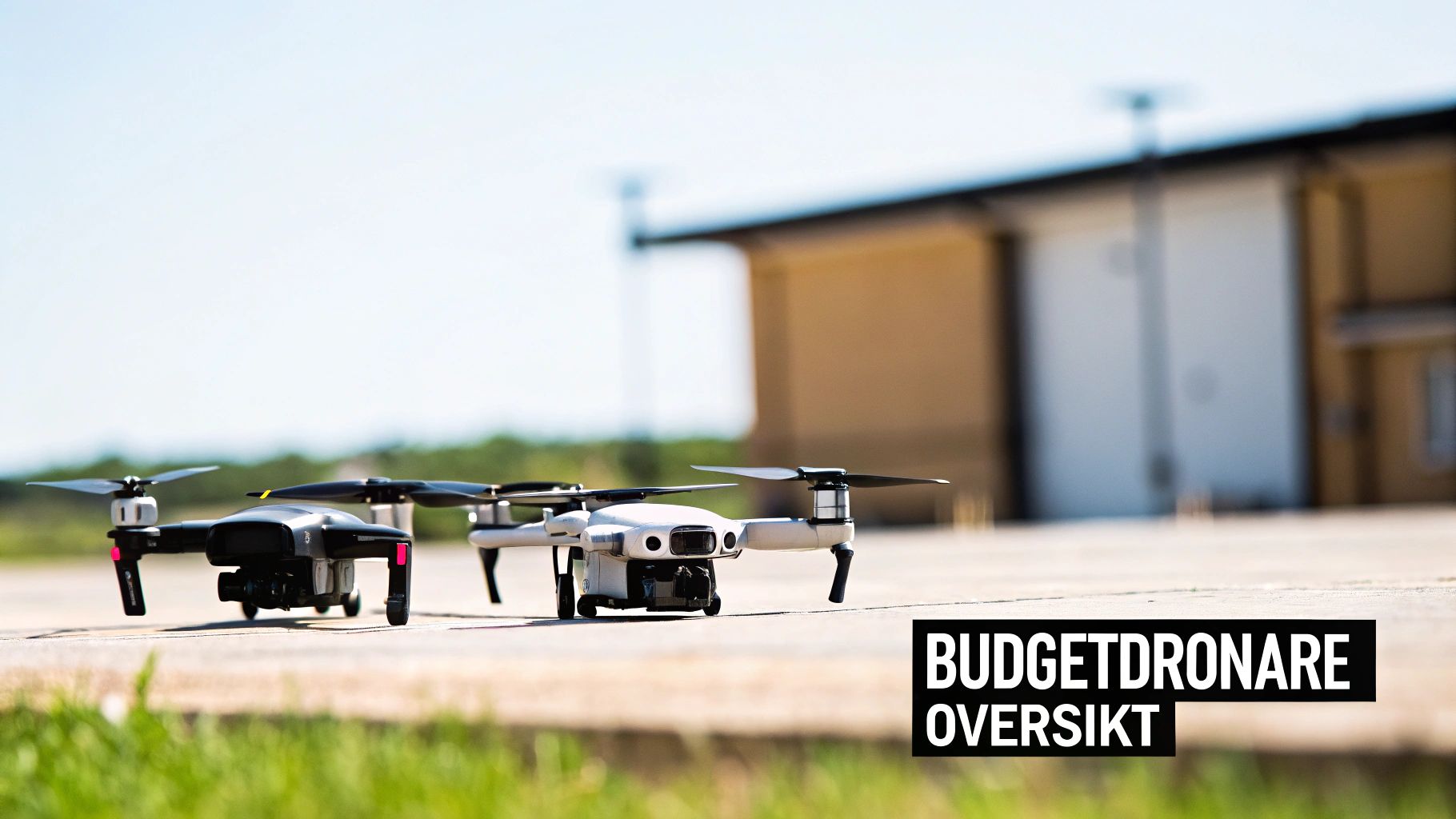
Choosing your first drone should be fun, not a headache. In the budget segment, it's all about getting maximum value for your money. This means you need to consider what is most important to you. Is a slightly sharper camera worth more than five extra minutes in the air? Or is a compact, foldable design what you really need for your outings?
For those new to this, features like "headless mode" (where the drone always flies in the direction you steer, regardless of which way the front is facing) and "auto-hover" (automatic altitude hold) are absolutely invaluable. These aids make your first flights significantly less stressful and reduce the risk of unnecessary crashes. If you want to dive deeper into what to look for, you can check out our complete guide to drones.
Comparison of Popular Choices
To give you a feel for what's out there, we've put together a simple overview of some of the most popular models right now.
Overview of the Best Budget Drones 2024
Here is a quick summary of some recommended budget drones, their key features, and who they are best suited for.
| Model | Approximate Price | Best For | Key Feature |
|---|---|---|---|
| Gear4Play Foldable | 500-800 SEK | Beginners and families | Good range for the price |
| Ryze Tello | 1000-1500 SEK | Hobby photographers on a budget | Electronic Image Stabilization |
| DJI Mini 2 SE | 3000-4000 SEK | Serious beginners | Long flight time & 2.7K video |
As you can see, there is something for most people. It's important to remember that a drone for $70 obviously can't compete with the image quality of one for $350, but it can still provide tons of flying joy and be a perfect way to get started.
A little tip: The stated flight time is almost always measured under optimal conditions. In reality, with a bit of wind and more active flying, expect it to be slightly shorter.
During 2024, we've seen increased interest in drones in the lowest price category, $30 to $70. It's primarily models with simpler cameras and beginner-friendly features that attract buyers. Tests show that even these cheaper alternatives have become surprisingly good, with some models now offering up to 7 minutes of flight time and a 40-meter range, which is very strong for the money.
What Actually Makes a Budget Drone Good?
What separates a truly great value drone from one that's just... cheap? The answer almost always lies in the details. It's about understanding which compromises you can live with and which ones simply ruin the entire experience.
Finding the best budget drone is a quest for balance. You have to weigh flight time, range, camera quality, and durability against each other. A drone might have an enticingly low price, but if the battery dies after four minutes, you'll barely have time to take off before it's time to land. That's not fun for anyone.
Flight Time and Range – Your Most Important Limits
A good budget drone should give you at least 7–10 minutes of flight time per battery. Anything less quickly becomes frustrating. Remember that manufacturers often state figures from perfect conditions, so read what other users say. Buying a couple of extra batteries is almost always a smart investment.
Range is just as important. A minimum of 40–80 meters is what you need to fly with a bit more freedom without constantly worrying about losing the signal. If the connection breaks, the drone could, in the worst case, just fly away, although many modern models have a built-in "return to home" function.
The Camera is More Than Just Megapixels
For many, the camera is half the reason for getting a drone. Here, it's very easy to be misled by specs like "1080p Full HD." A camera that films in high resolution is useless if the image shakes uncontrollably and the colors look dull.
The single most important feature for watchable video is image stabilization. Even simple Electronic Image Stabilization (EIS) makes a huge difference. Without it, the footage often becomes so shaky it's unusable.
A mechanical gimbal (a small motorized camera mount) is by far the best for getting smooth, fluid video, but it's rare in this price range. If you find a budget drone with a real gimbal, you've likely found a real bargain.
Easy to Fly = More Fun to Fly
A drone that is hard to control is a drone that will eventually crash. Especially for beginners, features that assist with flying are crucial. Look out for these two:
- Auto-hover (Altitude Hold): The drone stays at the same altitude when you release the sticks. This allows you to focus on steering it forward, backward, and sideways instead of constantly struggling with the throttle.
- Headless Mode: No matter which way the front of the drone is pointing, it always flies in the direction you push the stick. This removes the most common source of confusion and crashes for brand-new pilots.
Finally, don't forget build quality. A durable frame and easy access to spare parts like propellers can be the difference between a toy that lasts a week and a hobby that lasts for years. A winner in a "best budget drone" segment is the one that manages to hit all these points without costing a fortune.
Detailed Comparison of Top Models
When you start digging deeper into the models often appearing in "best budget drone" tests, the small differences suddenly become very large. It's no longer just about the price tag, but how each drone actually performs when you're out in the field. A spec sheet can look good, but it rarely tells the whole story.
To make the right decision, we must ask practical questions. How do the images look when the sun starts to set? Does the drone stay stable in the air when a gust of wind hits? And perhaps most importantly, how quickly can a beginner actually feel confident with the controls?
This infographic provides a quick overview of the three most important performance areas for budget drones: flight time, range, and camera capability.
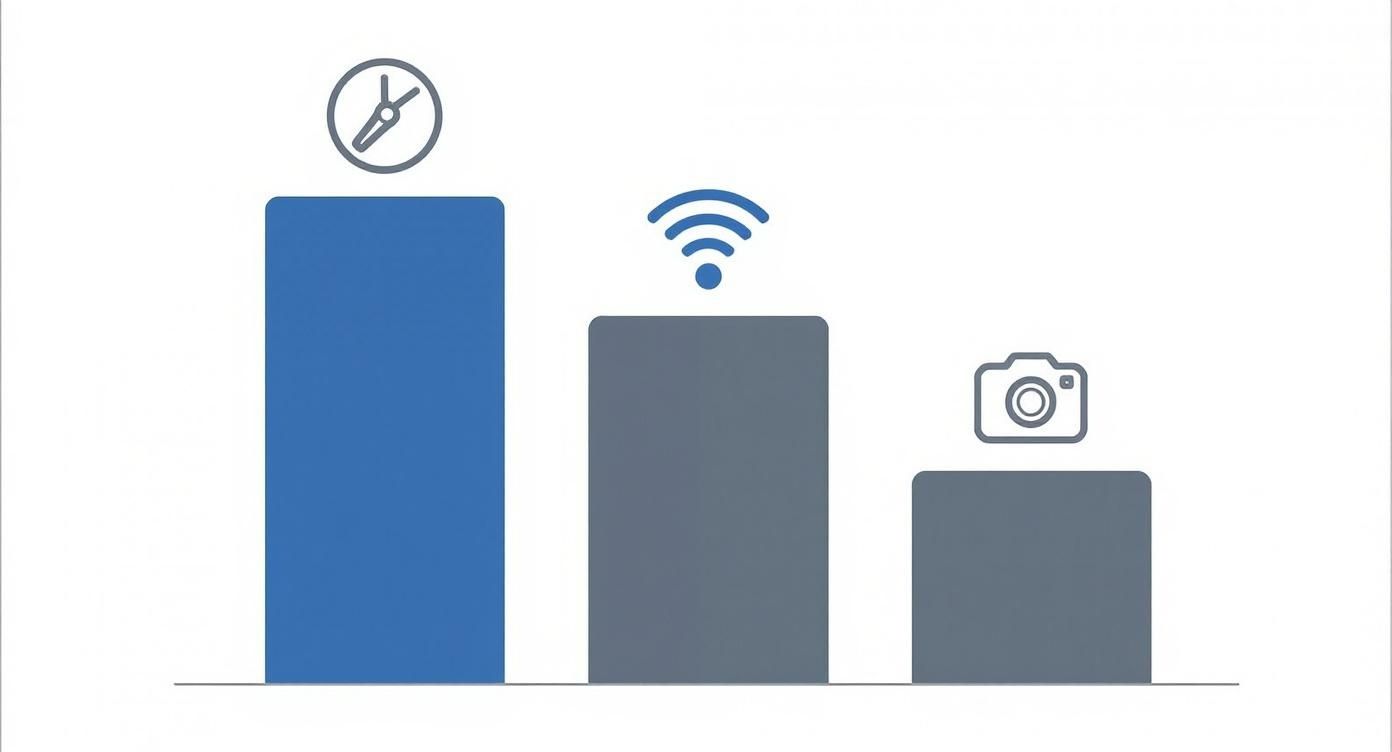
As you can see, cameras are often quite similar in this price range. Instead, it's the flight time and range that really separate the best models from the rest.
The Battle Over Flight Time and Range
Flight time is the single most important detail that will shape your experience. A drone that can hover for 15 minutes gives you a completely different creative freedom than one that must land after just 6 minutes. It’s the difference between having time to find the perfect angle and rushing to capture anything at all before the battery warning starts beeping.
Nordic consumers have become discerning; it's not just the price that counts, but battery life and real-world performance. In several Swedish tests from 2024, DJI's Mini series is highlighted as a clear benchmark. The DJI Mini 2 SE, for example, delivers up to 31 minutes of flight time on a single charge. That's more than twice as long as many competitors under $350. That advantage is hard to ignore, and you can read more in this detailed product overview.
Range is the other crucial piece of the puzzle. A drone with an 80-meter range works great for filming in the garden. But if you want to capture that grand view over a lake or a field, you'll quickly hit the limit. Models that handle 300 meters or more open up a whole new world of creative possibilities.
Camera Quality in Practice
Specs like 1080p or 2.7K only tell half the truth. How well the drone's sensor handles different lighting conditions and how effective the image stabilization actually is play a much larger role in the final result you see on the screen.
The absolute biggest divider in the budget class is whether the drone has a mechanical gimbal or not. A gimbal physically compensates for the drone's movements and shakes, resulting in smooth and professional video. Models with only Electronic Image Stabilization (EIS) don't stand a chance of matching this, especially when it's windy.
Imagine filming a sunset. A drone with a good sensor and gimbal captures the warm, soft colors without the video becoming shaky. A simpler model without a gimbal instead produces jerky video where colors feel washed out and details in the shadows completely disappear.
Ease of Use and Smart Features
For a beginner, intuitive controls and smart flight modes are worth their weight in gold. Models like the Ryze Tello and DJI Mini 2 SE really shine here. Both have easy-to-understand apps and features that make it incredibly simple to create great-looking video clips automatically.
- QuickShots (DJI): Pre-programmed maneuvers like "Dronie" or "Rocket" where the drone films you and then flies away dramatically.
- EZ Shots (Tello): Similar automatic flight modes that are perfect for recording short, shareable videos.
- Return-to-Home (RTH): A lifesaver. The drone automatically flies back to the takeoff point if the signal is lost or the battery gets too low.
These features aren't just fun toys; they build confidence and let you focus on creativity instead of struggling with the sticks. Often, it's specifically this that makes a good budget drone the best one for you.
Best Budget Drone for Photos and Video
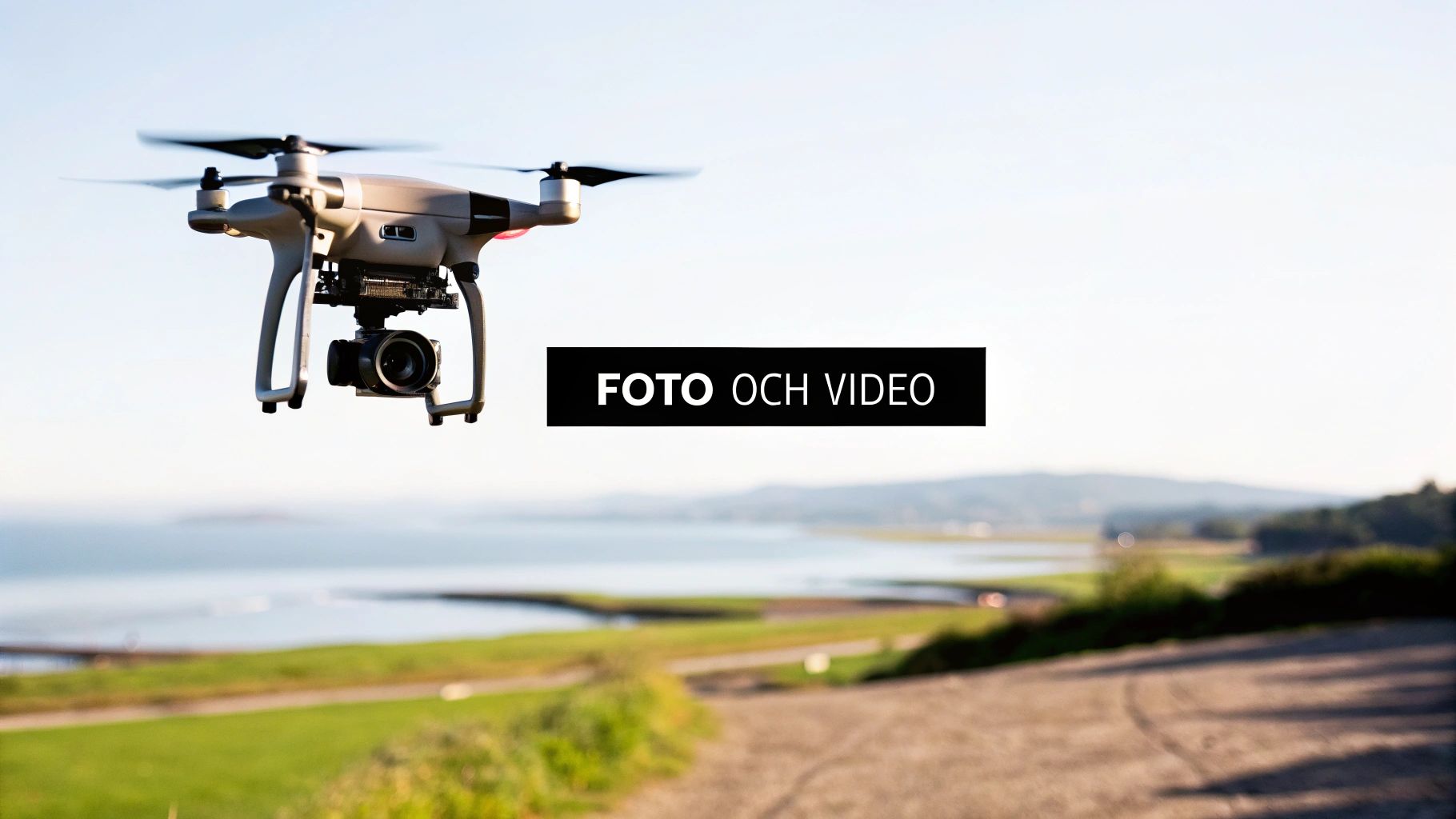
For most people, the camera is the heart of a drone. It's what transforms a fun flight into a chance to create truly beautiful images and video clips. When looking at the budget class, it's all about finding a drone whose camera performs well above its price tag. And here, the details make all the difference.
Sure, many cheaper models boast 1080p or even 4K, but resolution is only a small part of the truth. A shaky 4K video is practically unusable. That’s why image stabilization is the absolute most important factor to track when looking for the best budget drone for photos and filming.
Gimbal vs. Electronic Stabilization
The difference between a drone with and without real stabilization is like night and day. In the budget segment, two technologies primarily dominate:
- Electronic Image Stabilization (EIS): Here, the software in the drone works by digitally cropping the image to counteract small shakes. It’s a smart and cheap solution that makes a big difference compared to no stabilization at all.
- Mechanical Gimbal: This is a small, motorized rig that physically keeps the camera steady and compensates for the drone's movements. The result is a smooth, fluid, and professional feel in the video that EIS can never quite match.
Even if a drone with a 2- or 3-axis gimbal often costs a bit extra, it’s almost always worth the money if your goal is filming. The difference is enormous, especially as soon as there's a bit of wind.
A simple rule of thumb: For still photos, a drone without a gimbal can work, but for video you actually want to show off, some form of stabilization—and preferably a gimbal—is absolutely crucial.
A model that has become a real favorite during 2024 is the Ryze Tello. It is a perfect example of what you can get on a smaller budget. For around $120, you get a camera that takes 5-megapixel photos and films in 720p with electronic image stabilization—a feature that is rare in this price range.
Smart Features That Elevate Your Content
A good camera is only half the job. To truly create material that stands out, even as a beginner, smart software features are worth their weight in gold. They help you automate complex maneuvers that would otherwise take hours of practice.
Here are some of the most useful features to look out for:
- Follow Me: The drone locks onto an object (usually yourself) and follows automatically. Perfect for filming while cycling, skiing, or just taking a walk.
- Waypoints: Plot a route on the map in the app, and the drone flies it entirely on its own. This gives you smooth and precise camera movements that are nearly impossible to achieve manually.
- Orbit/Point of Interest: Choose a point, such as a tree or a building, and the drone circles gracefully around it while the camera remains pointed at the center.
These features allow anyone to create professional content. They remove the technical threshold and let you focus on the creative side. A budget drone with these tools can often yield more impressive results than a more expensive model that relies solely on manual steering. Finding the right balance between camera performance and smart flight modes is simply the key to success.
Important Rules and Tips for New Drone Pilots
Getting your first drone is an incredibly fun experience, but it’s also a responsibility. Before you even think about taking off for the first time, you need to be aware of the basic rules. It's not just about following the law, but about ensuring safety for yourself and others—and making sure your new hobby gets off to a positive start.
For most drones with a camera, regardless of weight, you as a pilot must register with your national aviation authority (such as the Transport Agency). The process is usually quite smooth and done entirely online. You receive an operator ID which you then mark visibly on your drone.
Basic Flight Rules You Must Know
Once registration is complete, there are a few golden rules that always apply. These rules are in place to protect both people on the ground and other air traffic.
- Always fly within line of sight: This is fundamental. You must be able to see your drone with the naked eye throughout the flight.
- Maximum flight altitude: Never fly higher than 120 meters (approx. 400 ft) above the ground.
- Respect privacy: Filming or photographing over people's gardens or homes without permission is a big no-no. Remember that data protection regulations (GDPR) also apply in the air.
- Keep your distance: Avoid flying over crowds, accident sites, or other sensitive areas. Common sense goes a long way.
Flying near airports, prisons, power plants, and national parks is strictly regulated and often completely prohibited. A pro tip is to always check a drone map/app before takeoff to see exactly where you are and aren't allowed to fly.
Tips for Your Very First Flight
Your first period as a pilot is all about building confidence and becoming one with your equipment. Take it easy; there's no reason to rush.
Start by finding a large, open area without obstacles like trees, buildings, or power lines. An empty football field or an open field is perfect for the purpose. Before you take off, make it a habit to do a quick calibration of the compass, just as described in the drone's manual.
A common mistake many beginners make is zooming upwards far too quickly. Instead, stay just a few meters high and practice hovering in place. Make small, controlled movements to feel how it reacts. Getting a landing pad for your drone is also a smart move—it protects the camera and propellers from dirt, grass, and dust during takeoff and landing.
Finally, don't forget the batteries. Store them half-charged if you don't plan to fly for a while, and avoid charging them immediately after a flight when they are still warm. This significantly extends their lifespan and performance, giving you more and safer hours in the air.
Frequently Asked Questions About Budget Drones
When diving into the world of budget drones, a lot of questions quickly arise. You might have read up a bit, compared a few models, but some concerns remain. To give you that final piece of the puzzle before you decide, we've gathered the most common questions—and answers.
It's often the small details that determine whether you'll be truly satisfied with your purchase in the long run.
How much difference does a gimbal make?
This is probably the most important question for anyone who wants to film. And the answer is simple: the difference is enormous. A drone without a mechanical gimbal, which instead uses digital stabilization (EIS), will yield a noticeably shakier result, especially if it's a bit windy.
A gimbal physically works with small motors to keep the camera completely still, regardless of how the drone moves. This is what creates that smooth, professional cinematic feel. If video is your thing, a budget drone with a gimbal is almost always worth the extra money. For still photos, it's not as critical, but for moving images, it's a total game-changer.
Do I really need extra batteries?
Yes, that is our strongest recommendation. The flight time figures provided by manufacturers are almost always measured in perfect, windless conditions. In reality, you can expect 10-20% shorter flight time than what is stated on paper.
With a typical flight time of 8-15 minutes per battery in this price range, time disappears incredibly fast. Having one or two extra batteries with you is the difference between a short, stressed flight and a relaxed session where you actually have time to find those perfect angles you're looking for.
Is a more expensive budget drone always better?
Not necessarily. Sure, a higher price within the budget segment (say $150 compared to $80) usually gets you better features like longer flight time, a sharper camera, or smart flight modes. But the most important thing is that the drone fits your needs.
A more expensive model with features you'll never use is no better a purchase than a cheaper one that does exactly what you want. Think about what's most important to you—is it that it's super easy to fly, the image quality, or that it's convenient to pack? For more advanced models, there is also much to learn, as you can see in our Q&A guide for the DJI Mini 4 Pro.
In the end, the best budget drone isn't the one that's best at everything, but the one that gives you the smartest compromise of features for your money.
Explore the Nordic region's largest selection of drone accessories at ActionKing. We have everything you need to maximize your flying experience, from extra batteries and propellers to guards and cases. Get equipped right from the start! Visit us at https://actionking.se.


